Quantum Computing: 7 Powerful Facts Every Beginner Must Know in 2026
Quantum computing in 2026 explained simply: how it works, real progress, security risks, and what beginners actually need to know.
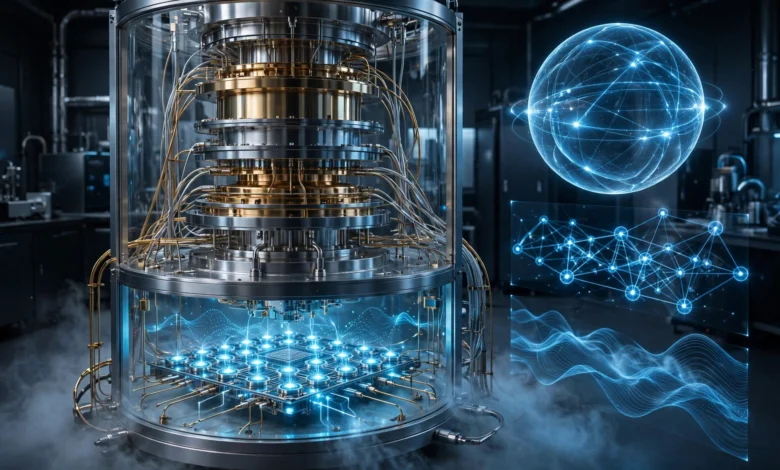
Quantum computing is no longer a lab curiosity tucked away in physics departments. By 2026, companies like IBM, Google, IonQ, and D-Wave are racing to prove something called “quantum advantage,” the point where a quantum machine solves a real-world problem faster than any classical supercomputer ever could. If you’ve heard the term thrown around in tech news, cybersecurity warnings, or finance headlines and felt a little lost, you’re not alone. Most explanations either drown you in physics jargon or oversimplify things to the point of being misleading.
This guide takes a different approach. It explains quantum computing the way you’d want a smart friend to explain it: clearly, honestly, and without hype. You’ll learn what a qubit actually is, how quantum computers differ from the laptop you’re reading this on, where the technology genuinely stands in 2026, and why governments and banks are quietly rebuilding their security systems around it. We’ll also look at real cybercrime cases tied to encryption weaknesses, because understanding what’s at stake makes the whole topic click. Whether you’re a student, a curious professional, or someone trying to figure out if this affects your job or your data, by the end of this article you’ll have a grounded, realistic picture of where quantum computing actually stands, not where marketing decks wish it stood.
What Is Quantum Computing, Really?
Quantum computing is a way of processing information using the principles of quantum mechanics rather than the classical physics that powers every phone, laptop, and server on the planet today. Regular computers store and process information in bits, tiny switches that are either 0 or 1. A quantum computer instead uses qubits, which can exist in a state that’s a mix of 0 and 1 at the same time, a property known as superposition.
Think of a classical bit like a coin lying flat on a table: it’s showing either heads or tails, plainly. A qubit is more like that same coin spinning in the air. Until you look at it (measure it), it’s in a blended state of both outcomes. This isn’t a metaphor stretched for effect; it’s the actual physical behavior researchers exploit.
Two properties make quantum computing genuinely different from anything before it:
- Superposition – a qubit can represent multiple states simultaneously, letting a quantum processor explore many possible solutions to a problem at once instead of one at a time.
- Entanglement – qubits can become linked so that the state of one instantly correlates with another, even when they’re physically separated. Google and IBM both rely heavily on entanglement to scale up their processors.
Because of these two properties, a quantum computer doesn’t just get faster in a linear way as you add more qubits, it can get exponentially more powerful for certain types of problems. That’s the theoretical promise. The practical reality, as you’ll see below, is more nuanced.
How Quantum Computers Actually Work
Understanding the mechanics of quantum computing doesn’t require a physics degree, but it does help to know the basic building blocks.
Qubits and Quantum Gates
Just as classical computers use logic gates (AND, OR, NOT) to manipulate bits, quantum computers use quantum gates to manipulate qubits. These gates rotate and combine qubit states in ways that let quantum algorithms perform calculations that would take a classical computer an impractical amount of time.
Hardware Approaches
Not all quantum computers are built the same way, and this matters because different hardware types have different strengths:
- Superconducting qubits – used by IBM and Google, these rely on circuits cooled to near absolute zero. IBM’s Nighthawk processor, unveiled in late 2025, is built on this approach and is central to the company’s push toward provable quantum advantage by the end of 2026.
- Trapped ion qubits – used by IonQ and Quantinuum, these use individual charged atoms controlled with lasers, generally offering higher qubit fidelity at smaller scale.
- Photonic qubits – used by companies like PsiQuantum, these encode information in particles of light, an approach some believe scales more easily.
- Quantum annealing – used by D-Wave, this is a more specialized approach focused on optimization problems rather than general-purpose computation.
Error Correction: The Real Bottleneck
Here’s the part most beginner guides skip: quantum computing hardware is extremely fragile. Qubits are easily disturbed by heat, vibration, and electromagnetic noise, a problem researchers call “decoherence.” A single stray vibration can corrupt a calculation. This is why quantum error correction, the process of using extra qubits to detect and fix mistakes, is considered the single biggest engineering challenge in the field.


Google’s Willow chip demonstrated a milestone in December 2024 by showing error rates that actually decreased as more qubits were added, called “below threshold” performance. That was a genuine turning point, because until then, adding more qubits usually meant adding more errors too.
Where Quantum Computing Actually Stands in 2026
This is the section that separates a grounded guide from hype. As of 2026, we are still in what researchers call the NISQ era, Noisy Intermediate-Scale Quantum computing. That means today’s machines are powerful research tools, but they are not yet reliable, general-purpose replacements for classical supercomputers.
A few concrete data points worth knowing:
- IBM’s Flamingo processor reportedly reached over 1,000 logical qubits by late 2025, and the company has publicly targeted verified quantum advantage by the end of 2026, with fault-tolerant quantum computing projected for 2029.
- Google’s Quantum AI division has run algorithms like “Quantum Echoes” showing speedups of roughly 13,000 times over classical supercomputers for narrow, specific molecular-simulation tasks, widely regarded as one of the first credible real-world demonstrations.
- IonQ and D-Wave are both expanding cloud access to their quantum hardware, letting businesses experiment with optimization and simulation problems without owning physical machines.
- No quantum computer today can break modern encryption standards or simulate large, complex molecules perfectly. Expert consensus and prediction markets both assign this a low probability within the next year or two.
In plain terms: quantum computing in 2026 is genuinely useful for narrow, specialized problems in chemistry, materials science, and optimization, but it is not yet the all-purpose “supercomputer killer” that headlines sometimes suggest. Most current applications are hybrid, meaning a quantum processor handles a specific hard sub-problem while a classical computer handles everything else.
Why Quantum Computing Matters for Cybersecurity
This is arguably the most important, and most misunderstood, part of the conversation. Much of the internet’s security, your bank login, encrypted messages, VPNs, cryptocurrency wallets, relies on mathematical problems that are extremely hard for classical computers to solve, like factoring very large numbers. A sufficiently powerful quantum computer running an algorithm called Shor’s algorithm could theoretically solve these problems fast enough to break widely used encryption like RSA and elliptic-curve cryptography.
We are not there yet. Researchers generally estimate a window of roughly a decade before quantum systems could pose what’s called a “cryptographically relevant threat.” But the concern isn’t purely theoretical, and history gives us a useful lens for why the stakes are real.
Real Cybercrime Cases That Show What’s at Stake
Understanding how encryption failures have already been exploited illegally helps explain why the security world is taking quantum threats seriously years in advance:
- The 2017 WannaCry ransomware attack exploited a known vulnerability in outdated Windows systems, encrypting data across hospitals, banks, and government agencies in over 150 countries. It wasn’t a quantum attack, it didn’t need to be. It showed how catastrophic it is when encryption and patching fail at scale.
- The 2013 breach of Adobe’s systems exposed millions of user passwords that were encrypted using a weak, outdated method, allowing attackers to crack a huge percentage of them with standard classical computing power. It’s a preview of what happens when cryptography lags behind the tools available to attackers.
- Historical cases of RSA key factoring challenges, where researchers and criminal groups alike have successfully factored deliberately weak or improperly generated keys, demonstrate that “unbreakable” encryption is really just “currently impractical to break.” Quantum computing threatens to shift that math dramatically.
These aren’t quantum crimes, they’re classical ones. But they illustrate exactly why the cybersecurity industry isn’t waiting for a working quantum code-breaker before acting. The lesson from every one of these cases is the same: encryption weaknesses get exploited eventually, and the cost of being unprepared is measured in real financial and human harm, not just headlines.
The Ethical Response: Post-Quantum Cryptography
Rather than treating this as a doomsday scenario, governments and standards bodies have spent years preparing. The U.S. National Institute of Standards and Technology (NIST) has been leading a multi-year international effort to standardize new encryption algorithms designed to resist attacks from both classical and quantum computers. You can review NIST’s post-quantum cryptography standardization project for the actual technical criteria being used to select these new standards.
This is the responsible, ethical path forward: build quantum-resistant systems before the threat materializes, not after. Organizations serious about long-term data security are already migrating toward these post-quantum standards, particularly for data that needs to stay confidential for decades, like medical records, government archives, and financial systems.
Real-World Applications Beyond Security
Quantum computing isn’t just a cybersecurity story. Some of the most promising near-term applications are far less dramatic but genuinely valuable:
- Drug discovery and materials science – simulating molecular interactions is exactly the kind of problem classical computers struggle with, and it’s where companies like IBM expect the first credible cases of quantum advantage to appear.
- Financial modeling – optimization problems in portfolio management, risk analysis, and fraud detection are well suited to quantum and hybrid quantum-classical approaches.
- Logistics and supply chain optimization – routing problems with enormous numbers of variables, the kind airlines and shipping companies deal with daily, are a natural fit for quantum optimization techniques.
- Climate and energy research – simulating chemical reactions relevant to battery technology and carbon capture is an active area of quantum research investment.
None of these are science fiction anymore. They’re active research programs with real funding, and some are already running limited pilot projects on existing quantum hardware through cloud platforms like IBM Quantum and Amazon Braket.
Common Myths About Quantum Computing
Because the field moves fast and gets oversimplified constantly, a few myths persist and are worth clearing up directly:
- Myth: Quantum computers will replace regular computers. Reality: quantum computers are specialized tools for specific problem types. Your laptop, phone, and most servers will keep running on classical architecture for the foreseeable future.
- Myth: Quantum computers can break any encryption instantly today. Reality: current hardware isn’t stable or large enough to run the algorithms that would threaten modern encryption at scale. That threat is years away, not days.
- Myth: Quantum computing is purely theoretical with no real progress. Reality: 2026 has already brought verified, if narrow, demonstrations of quantum advantage in specific scientific tasks, a genuine milestone.
- Myth: You need to understand quantum physics to work in this field. Reality: software developers, cybersecurity professionals, and data scientists are increasingly valuable in quantum computing without needing a physics PhD, thanks to accessible platforms like IBM’s Qiskit.
Getting Started With Quantum Computing as a Beginner
If this article has you curious about going deeper, here’s a realistic starting point rather than a vague suggestion:
- Try a cloud-based quantum platform. IBM Quantum offers free access to real quantum hardware and simulators through its Qiskit software development kit, no purchase or advanced degree required.
- Learn the basic math. You don’t need a physics background, but a comfortable grasp of linear algebra and probability will make quantum concepts click faster.
- Follow credible sources, not hype cycles. Organizations like the IEEE Quantum initiative publish grounded, peer-reviewed updates on where the field actually stands, a useful counterweight to speculative headlines.
- Understand the security implications for your own field. If you work in IT, finance, healthcare, or government, start asking whether your organization has a post-quantum cryptography migration plan. Many haven’t started yet, and early movers will have a real advantage.
Conclusion
Quantum computing in 2026 sits at a genuinely exciting but still early stage: real hardware milestones, real narrow demonstrations of advantage, and real security implications that responsible organizations are already preparing for, but not yet the all-powerful technology sometimes portrayed in headlines. Understanding how qubits, superposition, and entanglement actually work, alongside honest lessons from past cybercrime cases built on encryption weaknesses, gives you a far more useful picture than hype ever could. Whether you’re watching from the sidelines or considering getting hands-on with tools like Qiskit, the smartest move right now is staying informed, grounded, and realistic about both the promise and the timeline still ahead.