How to Choose the Right Smartwatch for Your Lifestyle
Walk into any electronics store or scroll through Amazon for five minutes, and you’ll see dozens of smartwatches claiming to be “the best.” Most of that noise doesn’t actually help you figure out which one fits your life. The truth is, there’s no single best smartwatch. There’s only the one that fits how you actually move through your day.
If you run marathons, you need something very different from someone who just wants text notifications on their wrist during meetings. If you spend your weekends hiking somewhere with no cell signal, battery life and GPS accuracy matter more than a fancy always-on display. And if you’re buying one for a parent who wants fall detection and an SOS button, none of the fitness-athlete features matter at all.
This guide walks through how to choose the right smartwatch based on what you actually need, not what a marketing page tells you to want. We’ll cover the technical factors that genuinely matter, how to match features to different lifestyles, and a few uncomfortable realities about counterfeit devices and data privacy that most buying guides skip over entirely. By the end, you should be able to walk into a store (or close a dozen browser tabs) and buy with confidence instead of guesswork.
Why “Best Smartwatch” Lists Usually Miss the Point
Most review sites rank smartwatches by raw specs: processor speed, screen resolution, number of sensors. That’s useful information, but it answers the wrong question. The right question isn’t “which watch has the most features,” it’s “which features will I actually use every day for the next two or three years?”
A smartwatch is a personal device you wear on your body for most of your waking hours. That means fit, comfort, and daily usefulness matter more than a spec sheet. Before you even look at models, it helps to ask yourself three honest questions:
- What do I actually want this watch to do for me (fitness tracking, notifications, safety, style)?
- What phone do I use, and does the watch I’m considering work well with it?
- How much am I willing to spend, and how often do I plan to replace this device?
Once you have honest answers to those, picking the right smartwatch for your lifestyle gets a lot simpler.
Key Factors to Consider Before You Buy
Battery Life
Battery life is probably the single most underrated factor in smartwatch satisfaction. A watch with incredible features that dies by 6 p.m. is a watch you’ll stop wearing within a month. Some smartwatches last 18 hours with the always-on display enabled, while others, especially those built around fitness and outdoor use, can run for a week or more on a single charge.
If you plan to use sleep tracking, you need a watch that can survive a full day and a full night without a charge. That rules out a lot of flagship smartwatches that prioritize screen quality over endurance.
Compatibility With Your Phone
Not every smartwatch plays equally well with every phone. Some watches are built almost exclusively for one ecosystem and lose major functionality when paired with a different operating system. Before buying, check:
- Whether the watch supports your phone’s OS fully, not just “basic pairing”
- Whether you’ll lose features like app notifications, music control, or voice assistants
- Whether software updates are still being actively released for that model
Skipping this step is one of the most common and most frustrating mistakes people make.


Health and Fitness Tracking Accuracy
Heart rate monitoring, sleep tracking, and step counting have gotten dramatically better over the past few years, but accuracy still varies a lot between brands and even between models from the same brand. If health tracking is your main reason for buying a smartwatch, look specifically at independent accuracy reviews rather than marketing claims. Wrist-based sensors are good, but they’re not medical-grade, and no smartwatch should be treated as a replacement for actual medical devices or a doctor’s evaluation.
Display and Design
Display technology affects both battery life and daily usability. AMOLED and OLED screens look vivid and support always-on display, but drain battery faster. Transflective or lower-power displays sacrifice some visual pop for much longer battery life, which matters a lot for outdoor or multi-day use.
Design matters too, more than people admit. A bulky sports watch looks out of place with business attire, and a sleek fashion-forward smartwatch often skips the rugged features that outdoor users need.
Price and Value
Smartwatches now span an enormous price range, from budget trackers under $50 to premium devices well over $700. A higher price doesn’t automatically mean a better fit for you. It’s worth asking what you’re actually paying for: cellular connectivity, premium materials, advanced health sensors, or simply brand name.
Matching a Smartwatch to Your Actual Lifestyle
This is where most buying guides get generic. Here’s a more practical breakdown by lifestyle.
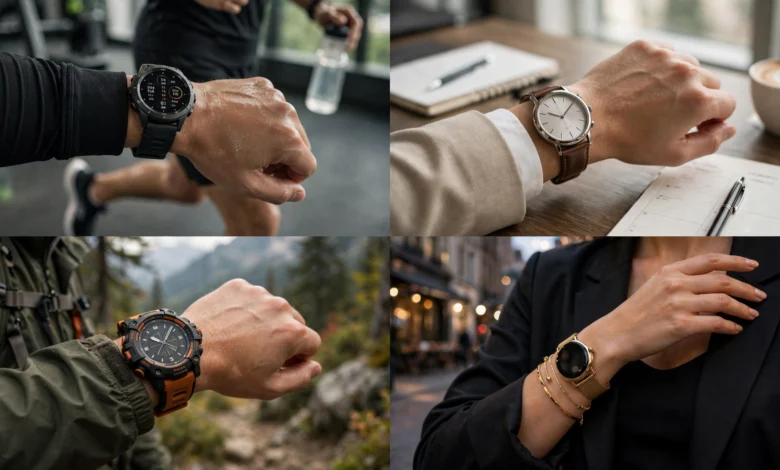
For Runners and Endurance Athletes
If you train seriously, prioritize GPS accuracy, multi-day battery life, and recovery metrics like heart rate variability. Look for:
- Built-in GPS (not phone-dependent GPS)
- Water resistance rated for swimming, not just splashes
- Training load and recovery tracking
- Compatibility with chest strap heart rate monitors for more accurate readings
For Office Workers and Professionals
If your day is mostly meetings, emails, and commuting, the priority shifts toward notifications, calendar integration, and a design that doesn’t look out of place with a blazer. Long battery life still matters, but extreme ruggedness usually doesn’t.
For Outdoor and Adventure Users
Hikers, climbers, and backcountry users need something closer to a tool than a gadget. Multi-day battery life, offline maps, altimeter and barometer sensors, and genuine ruggedness (not just marketing claims) are non-negotiable here.
For Everyday Casual Users
If you mainly want notifications, basic step tracking, and something that looks nice, you don’t need a $600 device loaded with sensors you’ll never use. A mid-range smartwatch with solid battery life and a clean interface will serve you better than an overloaded premium model.
For Older Adults and Safety-Focused Buyers
Fall detection, SOS calling, heart rate irregularity alerts, and simple, large-text interfaces matter far more here than fitness metrics. Several health organizations, including the Centers for Disease Control and Prevention, note that wearable devices can support fall prevention and health monitoring efforts for older adults, which is worth keeping in mind when buying for a parent or grandparent.
The Ethical and Safety Realities Most Guides Skip
Choosing the right smartwatch isn’t only about specs and lifestyle fit. There are real-world risks tied to this category of product that buyers should understand before handing over their money or their data.
Counterfeit and Grey-Market Devices
Counterfeit smartwatches are a documented and ongoing problem, not a theoretical one. Authorities have repeatedly seized shipments of fake smartwatches and other wearables branded to look like major names, sold through informal marketplaces and even some online storefronts. Buyers who purchased these devices often ended up with products that had no real safety certification, inaccurate sensors, and no warranty support at all.
To avoid this:
- Buy only from authorized retailers or the manufacturer’s own site
- Be suspicious of prices that are dramatically lower than every other retailer
- Check for proper safety certifications (FCC, CE, or your country’s equivalent) listed on the packaging
- Avoid sellers who refuse to provide a serial number or warranty documentation
The Federal Trade Commission has published consumer guidance on identifying counterfeit electronics and avoiding sellers who misrepresent product authenticity, and it’s worth a quick read before buying from an unfamiliar third-party seller.
Data Privacy and Location Tracking
Smartwatches collect an enormous amount of personal data: location history, heart rate, sleep patterns, and sometimes even microphone access. This isn’t hypothetical risk. There have been real incidents where fitness tracking data, aggregated and shared publicly by fitness apps, inadvertently revealed sensitive location patterns, including the locations of military personnel at secure facilities, because users hadn’t realized their activity data was shared publicly by default.
Before buying, check:
- What data the companion app collects and whether you can turn off specific tracking
- Whether your activity data is shared publicly by default (and how to disable that)
- Whether the company has a clear, readable privacy policy, not just a wall of legal text
This isn’t about avoiding smartwatches altogether. It’s about making an informed choice instead of accepting default settings blindly.
Common Mistakes People Make When Buying a Smartwatch
- Buying based on brand alone instead of checking whether the watch actually fits their phone and lifestyle
- Ignoring battery life in favor of screen quality, then regretting it within weeks
- Overbuying features they’ll never use, paying a premium for sensors that sit idle
- Skipping return policy research, which matters a lot given how personal fit and comfort are with wearables
- Not checking software support timelines, since older models sometimes stop receiving updates sooner than expected
A Simple Checklist Before You Buy
- Confirm compatibility with your phone’s operating system
- Decide on your non-negotiable features (battery life, GPS, health tracking, style)
- Set a realistic budget based on how long you expect to use the device
- Buy only from authorized retailers to avoid counterfeit risk
- Review the privacy settings and data-sharing defaults before first use
- Try it on if possible, comfort matters more than people expect
- Check the return and warranty policy before completing the purchase
Conclusion
Picking the right smartwatch for your lifestyle comes down to being honest about what you’ll actually use day to day, rather than chasing the longest spec sheet or the most hyped release. Match the device to your routine, whether that’s serious training, office life, outdoor adventure, or simply wanting cleaner notifications, and pay attention to the practical realities of battery life, compatibility, counterfeit risk, and data privacy along the way. Do that, and you’ll end up with a smartwatch you actually wear, instead of one that sits in a drawer after the first month.